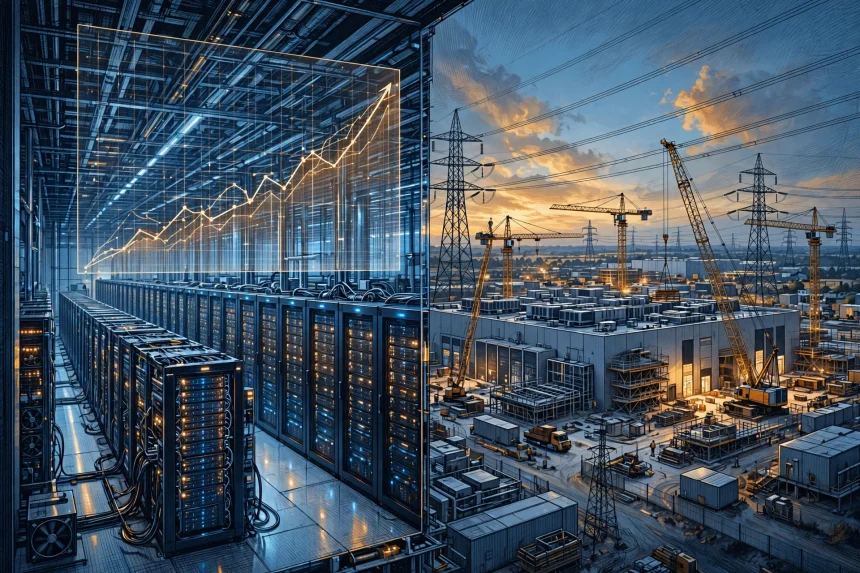
The artificial intelligence boom has a physical address: the data center. Behind every chatbot answer, generated image and automated summary sits a warehouse of specialised chips, cooling systems and power contracts — and the bill for building them is growing faster than the revenue the technology currently produces. New analysis highlighted this week suggests infrastructure spending on AI is forecast to outstrip expected revenue, reviving a question investors asked during every previous technology wave: how long can spending outrun sales before the math has to change?
The scale of the building spree
Major technology companies and their partners are committing sums that would once have been reserved for national infrastructure programmes. Data centers require land, grid connections, water for cooling, backup generation and thousands of graphics processors that become outdated within a few years. Unlike a software product, which can be copied at almost no cost, every new wave of AI demand requires real construction, real electricity and real money spent years before the revenue arrives.
That timing gap is the core of the problem identified by analysts and reported in detail by The Register. Spending is certain and immediate; revenue is projected and delayed. Companies are effectively building the factories for a market whose final size nobody knows, while competing fiercely not to be the one that built too little.
Why nobody wants to slow down
If the economics look stretched, why does the spending continue? Because the strategic risk runs the other way. In platform markets, the company with the most capacity, the best models and the widest developer ecosystem tends to set the standard everyone else must follow. Executives fear that cutting investment to protect this year’s margins could surrender the next decade’s market. That logic powered earlier build-outs in broadband, cloud computing and mobile networks, some of which looked excessive right up until demand caught up.
There is also a supply-chain race. Advanced chips, high-bandwidth memory and electrical equipment are constrained, so companies order early and in bulk to secure their place in line. Governments, eager to host strategic infrastructure, add incentives. Local communities, meanwhile, ask harder questions about power prices, water use and how many permanent jobs a largely automated facility actually creates — questions that now feature regularly in coverage of where digital industries go next.
Who ultimately pays for the boom
One widely shared estimate framed the issue in striking terms: the labour value implied by the spending is so large that, measured in jobs, paying for AI’s data centers would take more workers than the entire American workforce contains. However the exact figures are calculated, the point is about proportion. A technology sold partly on its ability to automate work is being financed at a scale that dwarfs the wages of the work it may replace, and the returns must eventually come from somewhere: higher prices for customers, greater productivity across the economy, or losses absorbed by investors.
For ordinary businesses, the most likely outcome is a period of experimentation followed by consolidation. AI services that are cheap today, subsidised by the race for market share, may become more expensive as providers try to convert usage into profit. Prudent managers are already responding by negotiating contracts carefully, keeping data portable and measuring whether each AI tool saves more than it costs — the same discipline we recommended when examining how to choose technology on value rather than hype.
Power is the real bottleneck
Money can be raised faster than electricity can be generated. In many regions the limiting factor for new data centers is no longer chips but grid capacity: substations, transmission lines and generation that take years to permit and build. That is why energy has become central to technology strategy, with companies signing long-term deals for nuclear, geothermal and renewable power, and why some projects are delayed not by lack of demand but by lack of a connection.
The power question also changes the politics. A data center that once arrived as a quiet warehouse development is now debated like a factory or a power station, because in energy terms that is what it is. Communities weighing tax revenue against pressure on local grids are making decisions that will shape where the AI industry can physically grow, regardless of how much capital it raises.
What happens if revenue catches up — or doesn’t
There are two broad endings to a spending wave like this. In the optimistic one, demand catches up: AI tools become indispensable in medicine, law, software, media and manufacturing, the expensive infrastructure fills with paying work, and today’s forecasts look conservative. In the harder ending, capacity exceeds demand, prices fall, weaker projects are written down and the surviving infrastructure is bought cheaply by a second generation of companies — a pattern the telecom industry knows well from the fibre glut of the early 2000s, which later became the backbone of the streaming era.
Either way, the buildings will not disappear, and neither will the technology. The real contest is over who bears the cost of the interval between spending and revenue, and who owns the assets when the market matures. For readers watching the headlines, the most useful habit is to separate announcements from arithmetic: how much was spent, what it earns, and how long the money lasts. In the AI boom, the math is now the story.