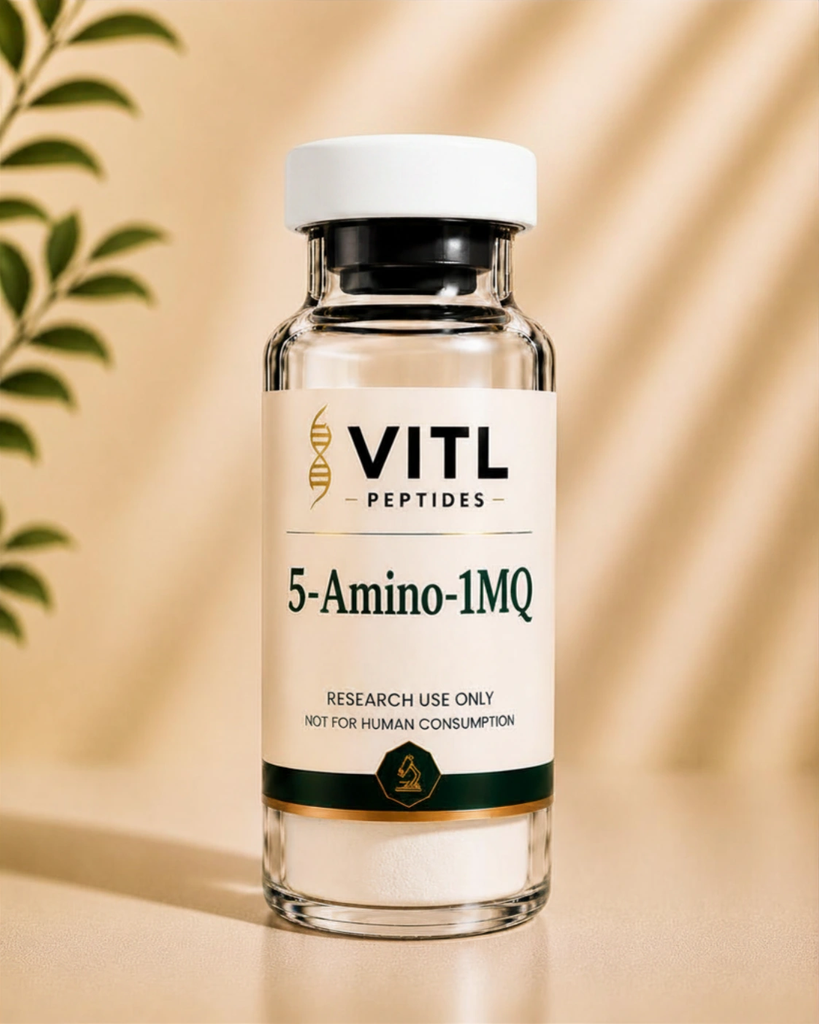
5-Amino-1MQ is a small-molecule compound investigated for its ability to inhibit nicotinamide N-methyltransferase (NNMT), an enzyme involved in cellular metabolism. Scientific interest centres on how NNMT regulates the use of nicotinamide and S-adenosylmethionine, two molecules connected to important biochemical processes. Researchers have examined whether inhibiting this enzyme changes metabolic activity in cultured cells and animal models. These findings provide a basis for further investigation, but they do not establish clinical benefits or safety in humans.
The 5-Amino-1MQ research compound is listed by VITL Peptides for research purposes. Understanding its scientific background requires distinguishing the compound’s proposed mechanism from the results observed in experimental settings. This distinction matters because early laboratory findings cannot automatically predict how a compound will behave in a living human system. Reviewing the enzyme, its substrates and the available research provides a clearer picture of what scientists currently know.
What Is 5-Amino-1MQ?
5-Amino-1MQ, also known as 5-amino-1-methylquinolinium, is a synthetic small molecule studied as an NNMT inhibitor. Despite appearing in catalogues alongside peptide products, it is not itself a peptide. Its research interest comes from its interaction with an enzyme that participates in nicotinamide metabolism and influences the availability of certain cellular metabolites.
The compound was investigated in research published on selective, cell-permeable NNMT inhibitors. The study examined its effects on cultured adipocytes and diet-induced obese mice, including changes in metabolites associated with NNMT activity. The findings supported further investigation of NNMT inhibition as a way to study metabolic regulation. They did not establish 5-Amino-1MQ as an approved medicine or demonstrate that it produces the same effects in humans.
Understanding NNMT and Its Biological Role
Nicotinamide N-methyltransferase is an enzyme that transfers a methyl group to nicotinamide, using S-adenosylmethionine (SAM) as the methyl donor. This reaction produces 1-methylnicotinamide (1-MNA) and S-adenosylhomocysteine (SAH). NNMT therefore connects nicotinamide metabolism with the biochemical pathways involved in methyl-group transfer. Researchers study the enzyme because changes in its activity can influence the balance of metabolites within cells.
NNMT expression varies between tissues and can change in particular biological conditions. Research has investigated its involvement in metabolic regulation, including its relationship with adipose tissue and energy-related pathways. However, the significance of NNMT depends on the tissue, biological context and experimental conditions. A change in enzyme activity should not be interpreted as proof of a beneficial or harmful outcome without further evidence.
How NNMT Connects with Cellular Metabolism
NNMT is relevant to several connected biochemical processes:
- Nicotinamide metabolism: The enzyme converts nicotinamide into 1-MNA through a methylation reaction.
- SAM utilisation: NNMT uses SAM, linking its activity to the availability of a major cellular methyl donor.
- NAD+ metabolism: Nicotinamide is also involved in pathways that help cells maintain NAD+ levels, so NNMT activity may affect the distribution of this metabolite between competing pathways.
- Metabolic regulation: Researchers investigate how changes in NNMT activity relate to lipid metabolism and other cellular processes.
These relationships explain why NNMT has attracted attention as a research target. They also show why results must be interpreted carefully, since altering one enzyme can affect several interconnected pathways.
How 5-Amino-1MQ Inhibition Is Studied
The proposed mechanism of 5-Amino-1MQ centres on inhibiting NNMT activity. In laboratory experiments, researchers can assess this interaction by measuring the production of 1-MNA and examining changes in related metabolites. A reduction in the reaction product provides evidence that the enzyme’s activity has been affected under the tested conditions. Additional measurements help determine whether the observed changes are associated with wider metabolic responses.
The published study, Selective and membrane-permeable small molecule inhibitors of nicotinamide N-methyltransferase reverse high fat diet-induced obesity in mice, investigated 5-Amino-1MQ alongside other NNMT inhibitors. Its experiments included cultured adipocytes and animal models, with measurements of NNMT-related metabolites and metabolic outcomes. The results support the compound’s use as a tool for studying NNMT inhibition, while leaving questions about translation to human biology unresolved.
What Researchers Measure in Experimental Studies
Researchers may examine several endpoints when investigating NNMT inhibitors:
- Enzyme activity: Measurements assess whether the compound changes the activity of the target enzyme.
- 1-MNA concentrations: Changes in this reaction product can help indicate the extent of NNMT inhibition.
- NAD+ levels: Researchers examine whether inhibition is associated with changes in this important cellular metabolite.
- SAM and SAH levels: These measurements help investigate the relationship between NNMT activity and methylation-related metabolism.
- Cell viability: Experiments assess whether the tested concentrations affect cell survival, helping researchers interpret other observations.
Each measurement answers a different question. A change in one metabolite does not establish a corresponding change in every other pathway, and findings from a cell culture cannot establish a clinical outcome.
What Does the Existing Research Show?
The direct evidence for 5-Amino-1MQ is primarily preclinical. Cell studies have reported reductions in 1-MNA following treatment, alongside changes in NAD+ and SAM under particular experimental conditions. The same research examined lipid accumulation in cultured adipocytes and metabolic outcomes in mice. These results provide mechanistic evidence for further investigation, but their relevance to human physiology remains uncertain.
Animal studies are useful for investigating biological processes across a more complex system than isolated cells. Even so, differences in metabolism, distribution, exposure and biological responses can limit the application of animal findings to people. Results also depend on the experimental design, the characteristics of the model and the measurements selected. Independent replication and additional research are needed before stronger conclusions can be drawn.
Preclinical Findings Are Not Clinical Evidence
The distinction between laboratory findings and clinical evidence should guide any discussion of 5-Amino-1MQ. Experimental changes in body weight, lipid accumulation or metabolic markers do not establish that the compound is an effective treatment for obesity or a metabolic disorder. They also do not establish an appropriate human dose, long-term safety profile or potential interactions with medicines. Claims about human outcomes require suitable clinical evidence.
For a broader discussion of NNMT biology, the review Nicotinamide N-methyl transferase (NNMT): An emerging therapeutic target examines the enzyme’s role and the challenges involved in developing inhibitors. The review provides useful context for understanding why NNMT is being studied, while also highlighting the limitations of the inhibitor research available.
Related Research Compounds and Product Documentation
VITL Peptides lists several materials for research use. These include lyophilized Thymosin Alpha 1 and lyophilized Tesamorelin + Ipamorelin. These are different compounds or formulations with their own research backgrounds, and their presence in the same catalogue does not establish a shared mechanism with 5-Amino-1MQ. Researchers should assess each product according to its identity, supporting documentation and intended research context.
Before reviewing any research compound, buyers should confirm the product description, available analytical documentation and batch information. Product records can help establish which material is being considered, while certificates of analysis may provide findings for specified quality attributes. The scope of each report should be checked rather than assuming that one result confirms every aspect of product quality. For questions about product records or ordering documentation, researchers can contact VITL Peptides.
Limitations and Questions for Further Investigation
Several questions remain open in the study of 5-Amino-1MQ. The available preclinical findings do not establish its pharmacokinetics in humans, its long-term effects or the extent to which the observed mechanisms translate to human biology. Further work would need to examine these issues using appropriate research methods before clinical conclusions could be justified. The relationship between NNMT inhibition and broader metabolic regulation also requires careful assessment across different experimental settings.
Researchers evaluating the literature should consider the following points:
- Whether findings have been independently replicated.
- Which cell types or animal models were used.
- Whether the reported changes were statistically and biologically meaningful.
- Which outcomes were measured directly and which were inferred.
- Whether human clinical evidence is available to support the claim being discussed.
These questions help separate established biochemical observations from hypotheses that still require testing. They also reduce the risk of treating an experimental mechanism as proof of a practical health outcome.
Conclusion
5-Amino-1MQ offers a research tool for investigating NNMT inhibition and its relationship with nicotinamide metabolism, NAD+ availability and methylation-related pathways. Published cell and animal studies provide a starting point for understanding its mechanism, but they do not establish human efficacy or safety. The most accurate interpretation keeps the biochemical findings separate from unproven clinical claims. Further well-designed research is needed to determine how much of the current evidence can be translated beyond preclinical models.
Frequently Asked Questions
1. What is 5-Amino-1MQ used for in research?
5-Amino-1MQ is studied as a small-molecule inhibitor of NNMT. Research examines how inhibiting this enzyme affects nicotinamide metabolism and related cellular processes. Its experimental role should not be confused with an established medical use.
2. What does NNMT do in the body?
NNMT is an enzyme that methylates nicotinamide, producing 1-MNA and using SAM in the process. This reaction connects nicotinamide metabolism with methyl-group transfer. Its effects depend on the tissue and biological context.
3. Is 5-Amino-1MQ a peptide?
No. 5-Amino-1MQ is a synthetic small molecule, not a peptide. It may appear in research compound catalogues alongside peptides, but its chemical classification and mechanism are different.
4. Does research prove that 5-Amino-1MQ causes weight loss in humans?
No. Published findings include cell experiments and animal studies, but these do not establish weight-loss effects in humans. Human efficacy and safety require appropriate clinical evidence.
5. What should researchers check when reviewing 5-Amino-1MQ documentation?
Researchers should check the compound’s identity, batch information, available analytical results and the scope of any certificate of analysis. They should also review the methods used in published studies and distinguish direct observations from proposed explanations. Product documentation does not replace independent assessment of the scientific evidence.