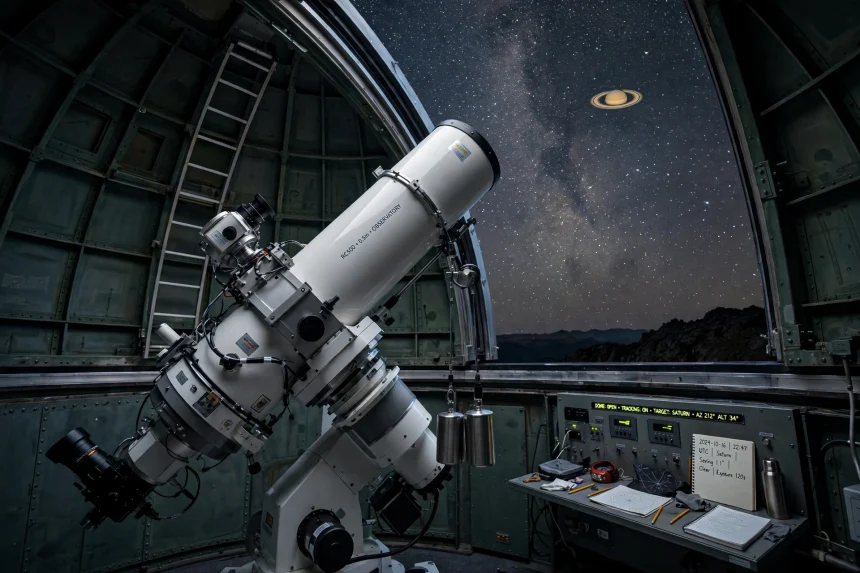
Saturn has a new headline figure: 274 moons. The confirmation of 128 additional satellites, identified in a long-running survey with the Canada-France-Hawaii Telescope, gives the ringed planet the largest confirmed moon system in the solar system by a wide margin and redraws the record books in a single announcement.
The newly recognised moons are irregular satellites — small, dark bodies, generally a few kilometres across, following distant and often steeply inclined orbits. Their formal recognition by the International Astronomical Union follows years of tracking to establish their paths with certainty.
Data, not drama: how the census grew
The discovery pipeline behind the announcement is a study in modern data practice. Astronomers collected repeated exposures of the sky around Saturn and stacked them along the planet’s line of motion, allowing objects far too faint for single frames to emerge from the noise. Candidates were then re-observed across multiple seasons.
Researchers at the University of British Columbia led the orbit analysis, and reporting in outlets including Nature has underlined the scale of the verification task: every one of the 128 needed an orbit precise enough to predict where it will be years from now.
It is a useful reminder, in a week when our coverage has focused on AI data centre spending outpacing revenue forecasts, that some of the most valuable datasets are still produced by pointing existing instruments at the sky for longer and processing the results more cleverly.
Families of fragments
The scientific return lies in the moons’ family structure. Irregular moons cluster into groups with near-identical orbital characteristics, interpreted as the debris of parent bodies destroyed by collisions after capture. A census enlarged by 128 changes the population statistics of every group it touches.
Those statistics constrain when collisions occurred and how much material the young Saturn system contained — inputs to the broader debate about how the giant planets formed and migrated into their present orbits.
A record with room to grow
Astronomers are the first to note that 274 is a floor, not a ceiling. Detection limits, not nature, set the current boundary, and both Saturn and Jupiter are expected to yield many more small moons as survey sensitivity improves.
The Vera C. Rubin Observatory’s decade-long sky survey should push the frontier considerably fainter. When it does, Saturn’s total will likely climb again — and the patient work of verification, not the headline, will once more be the real story.
What changes in the textbooks
A jump of this size forces revisions well beyond a single line in a reference book. Orbital dynamicists must update the models they use to describe how Saturn’s satellite system behaves as a whole, because 128 additional bodies — however small — alter the statistics of collisions, captures and ejections that those models try to reproduce. Family trees need redrawing: groups whose membership was estimated from a dozen moons can now be characterised with several dozen, and at least some previously solitary moons will turn out to have relatives.
The census also recalibrates expectations for the other giant planets. If stacking techniques can extract this many new moons from Saturn data, comparable reprocessing of Uranus and Neptune observations may yield additions there too — planets whose moon counts, 28 and 16 respectively, are widely believed to be severe undercounts driven by distance and faintness rather than by any real scarcity of satellites.
For the public record, the essential facts are simple to state and hard to overstate. Saturn: 274 moons, confirmed through years of observation and formal verification, with every indication that the true figure is higher. The record books have been rewritten before; rarely have they been rewritten by 128 entries at once.
The announcement also quietly demonstrates the value of open archives in astronomy. Because survey images are preserved and shared, independent teams can reprocess the same data, test the stacking software and verify candidate orbits for themselves. Few fields subject their headline numbers to that level of communal checking, and the moon census is stronger for it: 274 is not merely a claim, but a figure any competent group with the data could, in principle, reproduce.