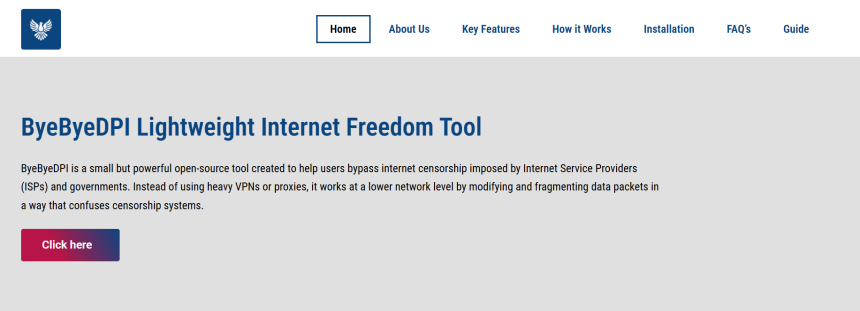
In 2026, internet censorship and traffic filtering technologies have become more advanced than ever. Many governments and ISPs now rely on Deep Packet Inspection (DPI) systems to monitor, restrict, or throttle online activity. In response, tools like byebyedpi have gained significant popularity among users who want faster, unrestricted, and lightweight access to the internet. Its rise is not accidental—it is driven by performance, simplicity, and modern bypass techniques that fit today’s restrictive networks.
Growing Demand for DPI Circumvention Tools
The global use of DPI-based filtering has increased sharply in recent years. Reports and open-source community discussions show that users in restricted regions are increasingly adopting DPI bypass tools instead of traditional VPNs due to speed and detectability concerns.
- DPI systems analyze packet content and patterns to block access.
- Many VPNs are now easily detected and throttled.
- Lightweight local tools like ByeByeDPI are gaining attention in technical communities.
According to open-source discussions in 2025–2026, DPI bypass tools such as ByeByeDPI, GoodbyeDPI, and Zapret are now widely used alternatives for users facing strict network filtering.
Lightweight Architecture and No Server Dependency
One of the biggest reasons ByeByeDPI is popular in 2026 is its local-first design.
Unlike VPNs:
- It does NOT route traffic through external servers
- It does NOT require paid infrastructure
- It works directly on the user’s device
ByeByeDPI modifies and fragments network packets locally before they leave the device, making DPI systems unable to easily analyze or block traffic patterns.
This design makes it:
- Faster than traditional VPNs in many cases
- Less resource-heavy
- More stable in weak network conditions
High Performance Compared to VPNs
Speed is one of the strongest factors behind ByeByeDPI’s growth.
VPN services often:
- Increase latency due to server routing
- Reduce download speed due to encryption overhead
ByeByeDPI:
- Does not create a full encrypted tunnel
- Only modifies packet behavior to evade detection
- Keeps direct connection to websites
Community reports in 2026 show that users often prefer DPI tools when streaming, browsing, or gaming because they introduce less delay than VPN-based solutions.
Adaptability Against Modern DPI Systems
Modern DPI systems have become more advanced, using:
- Full TCP stream reassembly
- Traffic fingerprinting
- Behavioral analysis of encrypted connections
To counter this, ByeByeDPI and similar tools constantly evolve their techniques, such as:
- Packet fragmentation
- Header manipulation
- Timing and sequence adjustments
Research-focused comparisons show that DPI tools are continuously updated to remain effective against evolving ISP filtering technologies.
Open-Source Community Support
Another major factor in popularity is its open-source ecosystem.
ByeByeDPI benefits from:
- Active developer contributions
- Rapid bug fixes and updates
- Community-driven improvements
- Free availability
Open-source transparency increases trust because users can verify how the tool works instead of relying on closed VPN services.
Ease of Use and Accessibility
In 2026, ease of use plays a major role in software adoption.
ByeByeDPI is popular because:
- It requires minimal setup
- Works in background mode or simple CLI execution
- Does not require account registration
- Runs on lightweight systems including Android environments
This makes it accessible even to non-technical users in restricted internet regions.
Why Users Prefer It Over Alternatives
Compared to traditional tools, ByeByeDPI is preferred because:
- VPNs → slower, detectable, subscription-based
- Proxies → unstable and limited
- Tor → very slow for daily use
- ByeByeDPI → fast, local, lightweight, free
This balance of speed and functionality makes it especially attractive in 2026.
Limitations Still Exist
Despite its popularity, ByeByeDPI is not perfect:
- It does NOT provide anonymity like VPNs
- It does NOT encrypt traffic
- It may not work against advanced censorship systems
- It requires technical updates to stay effective
So it is best seen as a circumvention tool, not a privacy tool.
Conclusion
byebyedpi has become popular in 2026 because it solves a specific modern problem: bypassing DPI-based censorship without sacrificing speed. Its local processing model, open-source nature, and performance advantages over VPNs have made it a preferred choice in restrictive internet environments.
However, its success also highlights a larger trend—the ongoing technical “cat-and-mouse game” between censorship systems and circumvention tools.