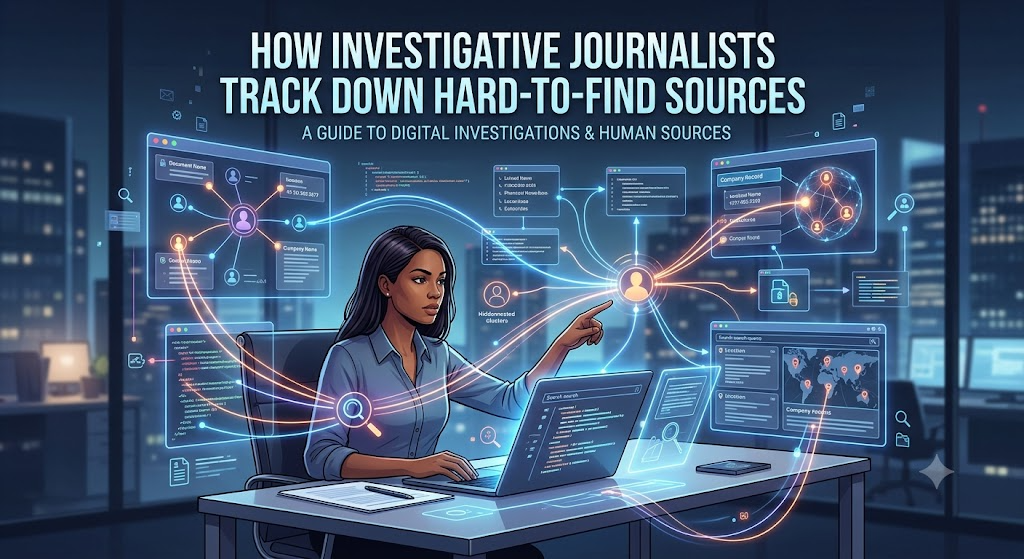
Investigative journalism has always lived or died by the quality of its sources. Whether uncovering corporate fraud, documenting government failures, or exposing social injustice, the ability to locate and verify the right people at the right time separates a good story from a great one. In an era of digital noise and information overload, journalists are increasingly turning to people-search tools and open-source intelligence techniques to cut through the clutter and find the individuals who hold the keys to their investigations.
The Modern Reporter’s Research Toolkit
Gone are the days when investigative reporting meant spending weeks in dusty county clerk archives or cold-calling every name in a phone book. Today’s journalists have access to a wide range of digital tools that allow them to trace individuals, verify identities, and piece together timelines with remarkable efficiency. People-search platforms have become a standard part of the investigative workflow, used alongside public records databases, court filings, property records, and social media intelligence.
These tools are not just about speed. They fundamentally change what is possible. A reporter working on a story about predatory lending, for example, might need to locate dozens of former customers scattered across multiple states. Without digital search tools, that kind of sourcing would be prohibitively time-consuming. With the right platform, a journalist can quickly find current contact details, cross-reference addresses, and identify patterns that would otherwise remain invisible.
One approach that has gained traction in newsrooms is using name-based search tools to locate individuals who have moved, changed their names, or deliberately made themselves difficult to contact. Services that help you find someone’s address through a name search have proven particularly useful for journalists trying to reach whistleblowers, former employees, or witnesses who no longer have a public digital footprint. The ability to pull current and historical address data from a single search dramatically compresses the time it takes to establish initial contact.
Building a Source Network From Scratch
Experienced investigative reporters often describe source development as the most labor-intensive part of any project. Unlike breaking news, where sources come to you, long-form investigations require journalists to actively build networks of people who have firsthand knowledge of the issue under scrutiny. This means reaching out to individuals who may be reluctant, afraid, or simply unaware that their experience is relevant to a larger story.
People-search tools fit naturally into this process. A reporter might start with a single name pulled from a court document, a company filing, or a tip from a reader. From there, they can use a search platform to identify associates, former colleagues, family members, or neighbors who might provide additional context. This web of connections, when mapped carefully, often reveals the shape of a story before a single interview has been conducted.
Verifying What You Find
Of course, locating a source is only the beginning. Verification is equally critical, and this is where disciplined use of multiple tools becomes essential. Journalists are trained to cross-reference any information they find through people-search platforms against independent sources such as property records, voter registration data, LinkedIn profiles, and court filings. No single tool is treated as definitive. Instead, these platforms serve as starting points for deeper verification.
Ethical considerations also play a significant role. Responsible journalists make clear distinctions between what is legally and publicly available and what crosses the line into invasive surveillance. Professional guidelines from major journalism organizations consistently emphasize that source research should be proportionate to the public interest served by the investigation.
When Investigations Go Global
Not all investigative work is local. Cross-border investigations present their own set of challenges, particularly when reporters are trying to trace individuals or financial flows across jurisdictions with limited data-sharing agreements. Journalists covering international corruption, for example, often need to build investigative frameworks that account for systemic failures in record-keeping, enforcement, and institutional accountability.
Research that traces these systemic problems to their root causes is invaluable in this context. Work like the detailed economic analysis found on this blog documenting corruption and infrastructure failures in India illustrates how rigorous, evidence-based research can support journalistic investigations by providing the structural context that individual sources alone cannot supply. Understanding the policy landscape, historical reform attempts, and comparative international data gives journalists a much stronger foundation when approaching sources and framing their stories.
What This Means for the Future of Reporting
The integration of people-search tools into investigative journalism is not a passing trend. It reflects a broader shift toward data-driven, digitally literate reporting practices that are becoming standard across the industry. Journalism schools are increasingly teaching open-source intelligence alongside traditional reporting skills. Newsrooms are hiring researchers and data specialists to support investigative teams. And the tools themselves continue to improve, offering more accurate, more comprehensive, and more ethically transparent ways to locate and verify individuals.
The core mission, however, remains unchanged. Investigative journalism exists to hold power accountable, amplify marginalized voices, and give the public the information it needs to make informed decisions. The tools are simply getting better at helping reporters fulfill that mission. In a media environment where trust is scarce and misinformation is abundant, the ability to find the right source, verify their identity, and tell their story accurately has never mattered more.
For journalists at every stage of their careers, building fluency with these tools is no longer optional. It is a professional imperative – and increasingly, a competitive advantage.