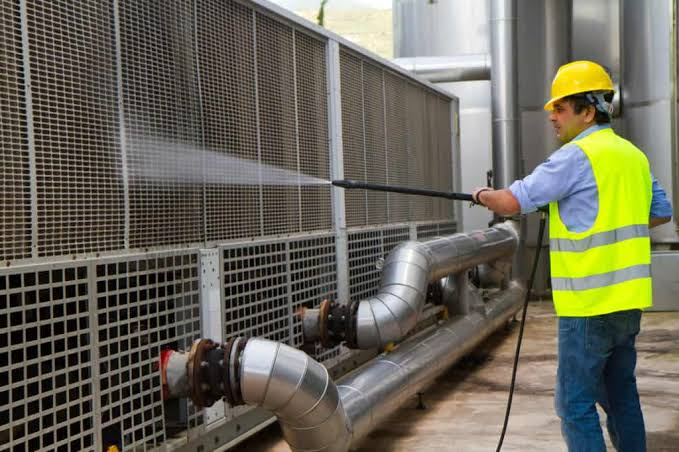
Cold water gives up first on a cold job
By the time a Canadian winter is well under way, trucks, trailers, and farm machinery carry a crust of road salt, frozen mud, and old grease that no amount of cold-water pressure seems to touch. The operator squeezes the trigger and the crust stays put, because the grease underneath has stiffened like cold butter. A hot water pressure washer changes that by warming the grease until it loosens, and it does so where the work is actually happening, in the yard or the shop bay.
Heat loosens grease, and loosened grease needs less force
Grease is thick because its molecules slide past each other slowly, and warmth speeds them up. Pour cooking oil from a cold pan and from a warm one and the difference is obvious. The same thing happens on a greasy axle or a concrete pad: water heated to a steaming 93 degrees Celsius, which the burner on this model can reach in under three minutes, thins the film so a degreaser can work into it and a rinse can carry it off. Heat does part of the job that pressure would otherwise have to do by force.
Pressure and flow do two different jobs
An industrial pressure washer is usually described by pressure, and about 4000 PSI is the figure on this one, but the number that decides how fast a surface comes clean is often flow. Pressure is the chisel: it concentrates force on a small spot and breaks the bond between dirt and surface. Flow is the river: at roughly four gallons per minute it carries the loosened material away before it can settle again. A machine with pressure and no flow polishes a small circle, while a machine with both clears a pad.
The two numbers also explain the engine. Multiply pressure by flow and divide by 1714 and the result is the hydraulic horsepower in the water jet, which for 4000 PSI at four gallons per minute comes to a little over nine. A 14 horsepower engine leaves room for pump losses and load spikes, which is why a machine with a small engine and a big pressure number deserves a second look.
The burner turns the washer into a small heating system
Hot water comes from a burner that heats the water as it passes through a coil, and on this model the burner is lit by a 12-volt ignition while a 14 horsepower Kohler engine drives the pump. Two combustion sources in one industrial pressure washer mean two exhaust streams, so it belongs outdoors or in a bay with real ventilation, never in a closed shed, because carbon monoxide has no smell. Keep the burner fuel fresh, and follow the manual’s cooldown routine before shutting down so the coil does not bake residue onto itself. In hard-water areas, scale also builds inside the coil and cuts heat transfer, so descaling on a schedule is routine care rather than an optional extra.
A hose reel earns its place in the cold
An 85-foot hose reel looks like a convenience until the first morning at minus twenty, when a stiff hose lying on frozen ground kinks, cracks, or drags the whole machine sideways. Winding it back onto the reel after every job keeps it off the ice, out of the wheel path, and free of the tight bends that wear a hose from the inside. With a good pressure washer hose reel the machine can stay in one spot while the hose reaches around a combine or a long trailer, which means fewer repositionings on slippery ground.
Nozzle angle and dwell time do the finishing
The nozzle sets how the jet is spread. A narrow tip concentrates force and suits flaked paint or baked-on grease on concrete, while a wider fan covers more area with less force and suits painted panels and glass. Start from a distance and move in only as far as the surface allows. Apply detergent through the low-pressure setting and leave it to dwell for a few minutes, since time on the surface is what lets a degreaser dissolve what heat has already softened. Rinsing too early is the most common reason people reach for more pressure.
What it handles well, and what to keep it away from
Picture a farm shop in midwinter where the equipment comes in coated in salt and silage grease. A hot water unit can clear the undercarriage and the shop floor in a single session, but the same stream aimed at wiring, bearings, or old paint would do damage. Plan the work around the limits as much as the strengths:
- Grease and oil on concrete pads
- Salt and mud on trucks and trailers
- Flaked paint before recoating
- Not for wiring, bearings, or delicate trim
Steam, pressure, and ice are the real hazards
Water at 93 degrees Celsius can scald in a fraction of a second, and a 4000 PSI jet can force water under the skin, an injury that looks minor and is not. Wear eye protection, gloves, and boots with good grip, never point the wand at a person or a foot, and lock the trigger whenever it is set down. Ice is the quiet hazard, since runoff freezes into a skating rink around the wash bay. Before the first hard freeze, drain the pump and lines as the manual describes, because a cracked pump is an expensive way to learn about winter.
Wash water is not just water
Grease and oil rinsed off equipment should not run into a storm drain. Municipal and provincial rules differ, so check them before washing on a gravel apron, and consider a contained pad or an oil separator where the volume justifies one. Heat helps here too, because warm water lifts grease with less detergent, which keeps the load in the runoff lighter.
Where yard cleaning is heading
Fleet and farm operators are asking more of their wash equipment: less detergent, cleaner runoff, and a machine that works in deep winter as well as high summer. Electric and hybrid fleets are likely to put more sensitive components under the vehicle, which makes controlled hot water more useful, not less. The choice between a cold industrial pressure washer and a heated one comes down to the dirt, and a quick look at what is actually on the equipment usually settles it. If it is mostly mud, cold water is fine, and if grease is the problem, heat does the work that extra pressure cannot. TMG Industrial offers this model with a 14 horsepower engine and an 85-foot hose reel for operators who clean in the cold.