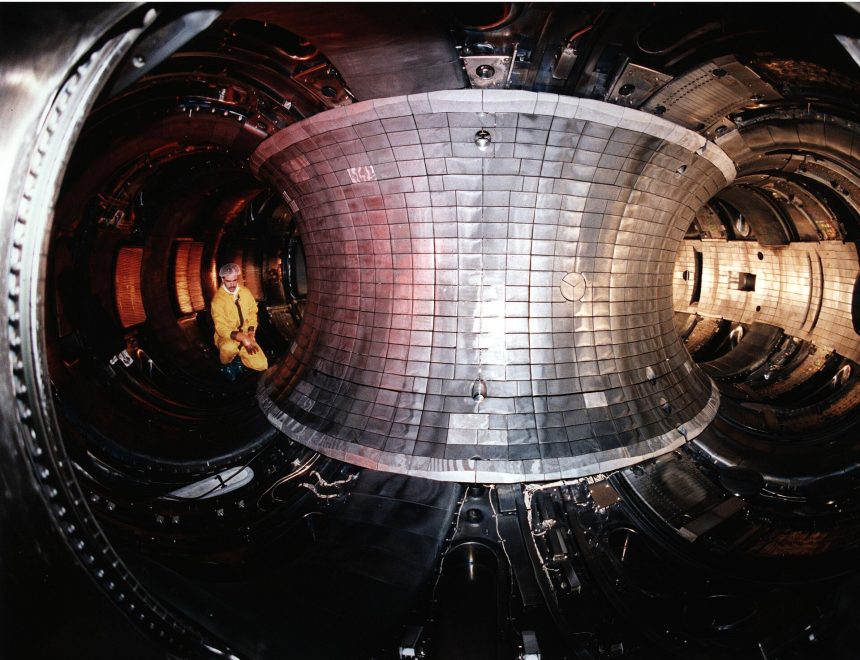
Fusion energy’s oldest joke — always thirty years away — is being retired by an unlikely force: venture capital with deadlines. Private fusion companies have raised well over seven billion dollars, employ thousands, and are commissioning a generation of machines designed to prove, within this decade, that a reactor can produce more energy than it consumes at the plasma level and approach the engineering conditions a power plant needs. The public programme, anchored by the multinational ITER experiment, continues on its own monumental timetable. Between them, the field has shifted from a physics question to an industrial one.
The private designs diversify the bet. High-temperature superconducting magnets — the enabling technology of this era — let tokamaks shrink dramatically, trading ITER’s scale for field strength. Stellarators, laser-driven inertial systems and magnetised-target designs each advance their own claim to be the configuration that survives contact with economics. Progress markers compiled by the Fusion Industry Association‘s annual surveys show the pattern: most companies target demonstration milestones in the late 2020s, and the first pilot-plant announcements now name grid connection dates in the early 2030s. Government programmes, including the US Department of Energy‘s milestone-based funding, increasingly buy into private timelines rather than only funding their own.
How to Read the Claims
Scepticism remains a healthy instrument, provided it is calibrated. Plasma gain is not wall-plug gain; a machine that produces net energy in the fuel for microseconds has not produced electricity, steam, uptime or a business. The milestones that matter, physicists advise, are boring-sounding: sustained operation, components surviving neutron bombardment, tritium breeding, and cost per unit of installed capacity. On those measures the field is early but genuinely moving, helped by supply chains — superconductors, power electronics, precision manufacturing — maturing for other industries simultaneously. Follow the energy transition in our science coverage.
The Stakes If It Works
The Supply Chain Is the Real Milestone
Fusion’s progress is best measured not in plasma records but in purchase orders. The industry now consumes high-temperature superconducting tape in quantities its manufacturers once only promised, precision components machined to tolerances borrowed from aerospace, and a workforce of plasma physicists that universities cannot graduate fast enough. A supply chain is an ecosystem’s proof of seriousness: suppliers invest in capacity only when they believe the orders repeat, and their investment is what turns a demonstration into an industry. The remaining scientific hurdles — materials that survive years of neutron bombardment, tritium breeding blankets that make their own fuel — are engineering programmes now, staffed and funded as such. Whether the first commercial plant arrives in the 2030s or slips, the transformation is already visible in the industrial base: fusion has stopped being a physics experiment with a press office and become a manufacturing sector with a physics problem.
The investment structure has changed fusion’s failure mode, which may matter as much as its physics. A government megaproject can be cancelled by one budget vote; seventy private ventures in a dozen countries cannot be cancelled by anything short of the idea itself failing. The portfolio logic — many designs, many teams, shared supply chains, knowledge spilling between rivals — is the venture model applied to the hardest problem in energy, and it means the field now fails forward: each abandoned design leaves its magnets, its materials science and its trained people inside the industry. Fusion’s sceptics have history on their side and a new structure against them. The race worth watching is between the physics and the portfolio.
A working fusion plant is firm, clean, fuel-abundant power with no long-lived waste problem — the missing complement to cheap but variable renewables. Even the credible path runs through the 2030s before meaningful grid contribution, which makes fusion a technology for the second half of the century rather than a rescue for the first. But centuries matter. The private era’s contribution may prove to be less the machines themselves than the deadline culture: a field that now has to show its work, on schedule, in public.