In the cloud era, every enterprise operates under the “Shared Responsibility Model”—a crucial concept dictating that while the cloud provider secures the underlying infrastructure, the customer is responsible for the security in the cloud. This means securing configurations, data, access management, and operating systems. This division of labor is where most security breaches originate, transforming cloud agility into significant risk. Cloud Infrastructure Managed Services (CIMS) provide the specialized, 24/7 security expertise necessary to meet this demanding obligation, acting as an indispensable security shield for your digital assets. To understand the critical role CIMS plays in fortifying your defenses and ensuring continuous compliance across complex, multi-cloud environments, consult the comprehensive knowledge base offered by Opsio Cloud via our dedicated guide to cloud infrastructure managed services.
The reality is that your infrastructure is only as secure as its weakest configuration. By entrusting your governance, security policy enforcement, and proactive threat detection to experts, you mitigate the risk of human error and talent gaps. Providers like Opsio Cloud ensure your security posture is always robust, compliant, and ready for immediate incident response, allowing your internal teams to build new features with confidence, not fear.
Section 1: The Critical Vulnerability: Misconfiguration and The Talent Gap
The shared security model is clear, yet customer misconfiguration of security settings—particularly Identity and Access Management (IAM), firewall rules, and storage bucket policies—remains the leading cause of cloud data breaches. The complexity of the risk is driven by two factors:
- The Attack Surface: A modern cloud environment is vast, encompassing numerous APIs, thousands of endpoints, and continuous code deployments, all of which must be secured simultaneously. A small internal team simply cannot monitor this attack surface effectively 24 hours a day.
- The Talent Scarcity: Hiring and retaining dedicated SecOps engineers with multi-cloud expertise (AWS, Azure, GCP security services) is prohibitively expensive and fiercely competitive. The knowledge required to stay ahead of evolving threats often surpasses the internal capacity of many organizations.
Cloud Infrastructure Managed Services directly address these vulnerabilities by providing an always-on, expert security team integrated directly into your infrastructure operations.
Section 2: CIMS as Your 24/7 Security Operations Center (SOC)
A mature CIMS offering elevates infrastructure security from a manual, reactive task to a proactive, automated discipline. The provider’s role is to ensure all security measures are implemented at the infrastructure layer and maintained without fail.
A. Proactive Threat Monitoring and Detection
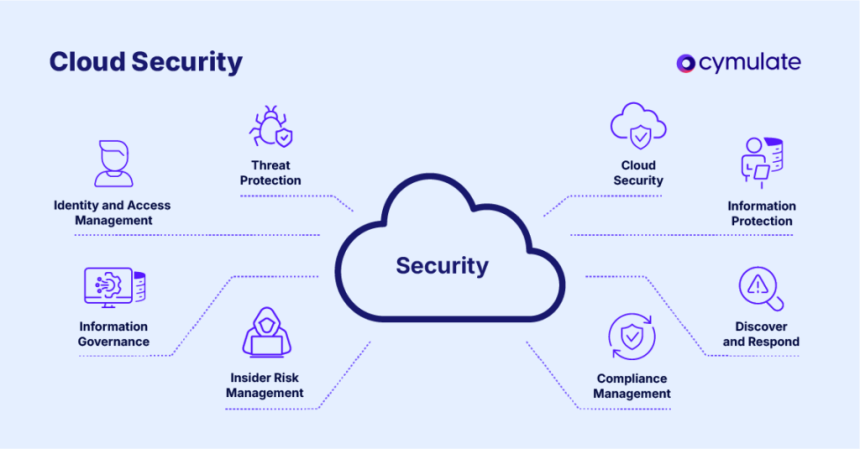
CIMS includes continuous monitoring of security logs, network traffic, and behavior analytics using advanced tools like AWS GuardDuty and Azure Sentinel. This capability allows the provider to:
- Identify Anomalies: Detect unusual login attempts, unauthorized API calls, or lateral movement within the network instantly.
- Automated Remediation: Implement automated responses (SecOps automation) to immediately quarantine compromised resources or revoke suspicious access, often resolving the threat before it triggers a manual alert.
B. Identity and Access Management (IAM) Governance
IAM is the foundation of cloud security. CIMS providers implement the principle of Least Privilege, ensuring that every user and automated service only has the absolute minimum permissions required to perform its function. This involves:
- Role Management: Creating, auditing, and enforcing precise roles and policies across all cloud environments.
- Access Review: Conducting regular, automated audits of user and service account privileges to immediately revoke stale or excessive access rights.
C. Automated Patch and Vulnerability Management
Security is constantly eroded by unpatched vulnerabilities. CIMS integrates automated patching for operating systems and middleware components, ensuring that your infrastructure is always up-to-date against the latest CVEs (Common Vulnerabilities and Exposures), reducing the attack surface to the bare minimum.
Section 3: Ensuring Continuous Compliance and Audit Readiness
For regulated industries, security is synonymous with compliance. Cloud Infrastructure Managed Services simplify the complex process of achieving and maintaining regulatory adherence.
1. Policy Enforcement and Audit Trails
A managed provider implements security governance frameworks (e.g., CIS Benchmarks) as code, ensuring policies are enforced consistently across every cloud resource. Crucially, CIMS automatically collects, time-stamps, and secures evidence of compliance, creating a detailed audit trail for every change. This documentation is invaluable during official audits for standards like HIPAA, SOC 2, ISO 27001, and PCI DSS.
2. Security Posture Management
CIMS utilizes specialized tools to continuously assess the entire infrastructure against compliance standards. Any configuration drift—a resource falling out of compliance—is immediately flagged and automatically corrected. This ensures a persistent state of readiness, eliminating the scramble that often precedes a compliance audit.
3. Disaster Recovery (DR) and Business Continuity
Security extends to resilience. CIMS ensures that robust, tested Disaster Recovery plans and automated backup strategies are in place across multiple regions or clouds. This safeguards data availability against cyberattacks, ransomware, and physical outages, which is a key component of operational security.
Section 4: Strategic Security Partnership with Opsio Cloud
Mitigating infrastructure risk requires a partner who understands both security architecture and industrial scale. Opsio Cloud delivers highly specialized cloud infrastructure managed services focused on risk mitigation.
Our certified security experts architect environments to the highest standards, ensuring secure-by-design principles are implemented from the initial deployment and maintained throughout the operational lifecycle. We provide transparent reporting on your security posture, allowing you to prove compliance to stakeholders and regulators. By integrating deep SecOps expertise with robust governance, Opsio Cloud transforms your cloud infrastructure from a source of potential vulnerability into a reliable, audited security shield, giving your business the peace of mind to focus on growth.